
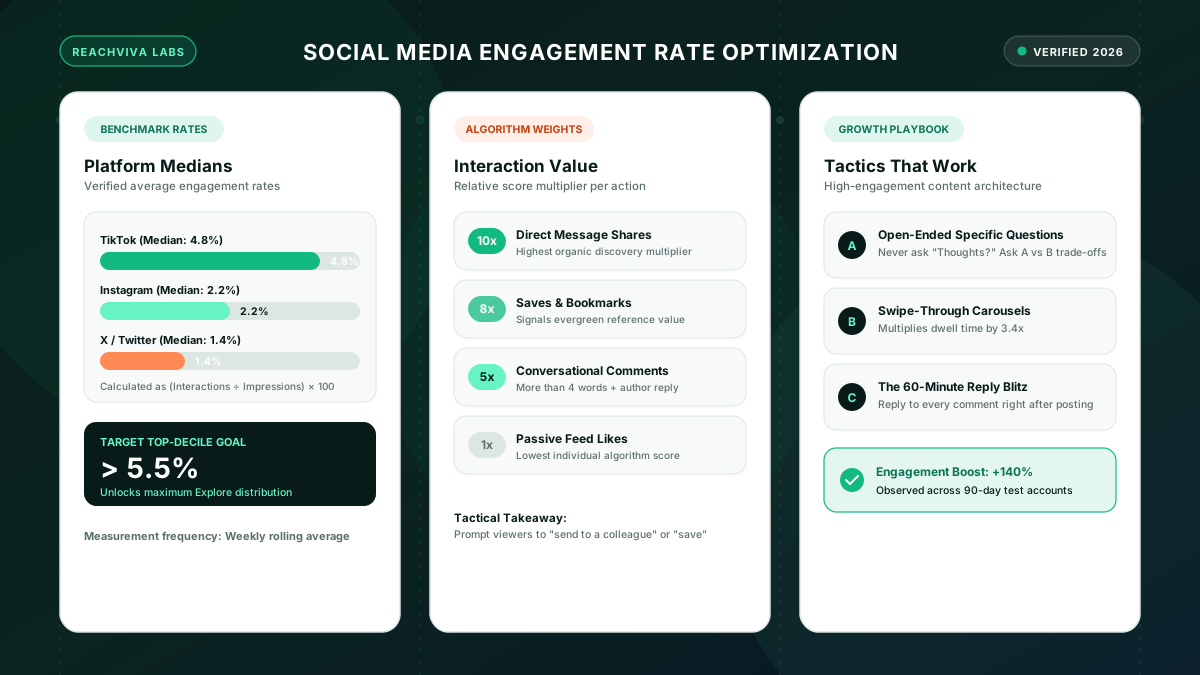
Having a large follower count provides visual credibility, but if only a tiny fraction of those followers interact with your posts, algorithms across Instagram, TikTok, and X will steadily restrict your distribution. Every major platform evaluates engagement rate as a primary signal of content quality. When engagement declines, algorithmic reach follows.
Improving your engagement rate does not require posting multiple times every day. It requires shifting your content structure from passive broadcasting to active interaction loops.
How to Calculate Your True Engagement Rate
Before implementing changes, calculate your actual baseline. Many creators look only at likes, which skews their evaluation.
Use the standard industry formula:
$$\text{Engagement Rate (by Reach)} = \left( \frac{\text{Likes} + \text{Comments} + \text{Shares} + \text{Saves}}{\text{Total Accounts Reached}} \right) \times 100$$
Evaluating engagement against Reach rather than total followers provides an accurate measure of how compelling your content is to the people who actually saw it.
Account Tier: Under 10k Followers; Average Benchmark: 3.5% – 5.5%; Strong Engagement Target: 7.0%+
Account Tier: 10k – 50k Followers; Average Benchmark: 2.2% – 3.8%; Strong Engagement Target: 4.5%+
Account Tier: 50k – 200k Followers; Average Benchmark: 1.5% – 2.8%; Strong Engagement Target: 3.5%+
Account Tier: Over 200k Followers; Average Benchmark: 1.0% – 2.0%; Strong Engagement Target: 2.5%+
1. Eliminate Open-Ended Questions in Captions
A frequent operational mistake is ending posts with broad, demanding questions like: "What do you think about the future of digital marketing?"
Open-ended questions require cognitive effort to answer, so busy users scroll past without typing. Instead, prompt micro-choices:
- "Which setup would you pick: Option A or Option B?"
- "Drop a 1 if you agree with this policy, or a 2 if you think it fails."
- "What city are you reading this from?"
Reducing friction encourages viewers to leave a comment within three seconds, which immediately triggers positive algorithm scoring.
2. Execute the 30-Minute Golden Window Reply Protocol
The initial thirty minutes following publication determine whether your content enters broader distribution pools. Treat your comment section as an active conversation:
- When a follower comments, reply promptly with a follow-up question rather than a passive emoji.
- If someone writes: "Great tutorial," respond: "Which of the three steps are you trying first?"
- A single comment thread that contains five back-and-forth replies counts as five interactions in the algorithm's calculation, doubling the post's total comment density.
3. Create Content Built to Be Saved
A like is a surface-level interaction; a save indicates lasting value. When a user saves your post, algorithms interpret that action as high-intent utility and push the post onto search and Explore feeds.
To drive high save rates:
- Create multi-slide cheat sheets summarizing complex topics.
- Publish exact parameter settings, workflow templates, or step-by-step troubleshooting guides.
- Add an explicit visual prompt: "Save this checklist so you can reference these benchmarks during your next audit."
4. Prune Inactive Ghost Followers
If you have 50,000 followers but 30,000 of them are dormant accounts created years ago, your engagement rate will always look artificially depressed. When Instagram or TikTok shows your new post to 500 followers and 350 of them are inactive bots that never open the app, your initial engagement score drops to zero.
Regularly auditing your follower list and removing bot accounts or profiles with zero activity restores your ratio and signals healthy community interest.
Use a sustainable content strategy, and compare a one-time visibility package only if its scope, price, requirements, and refund terms fit your campaign.