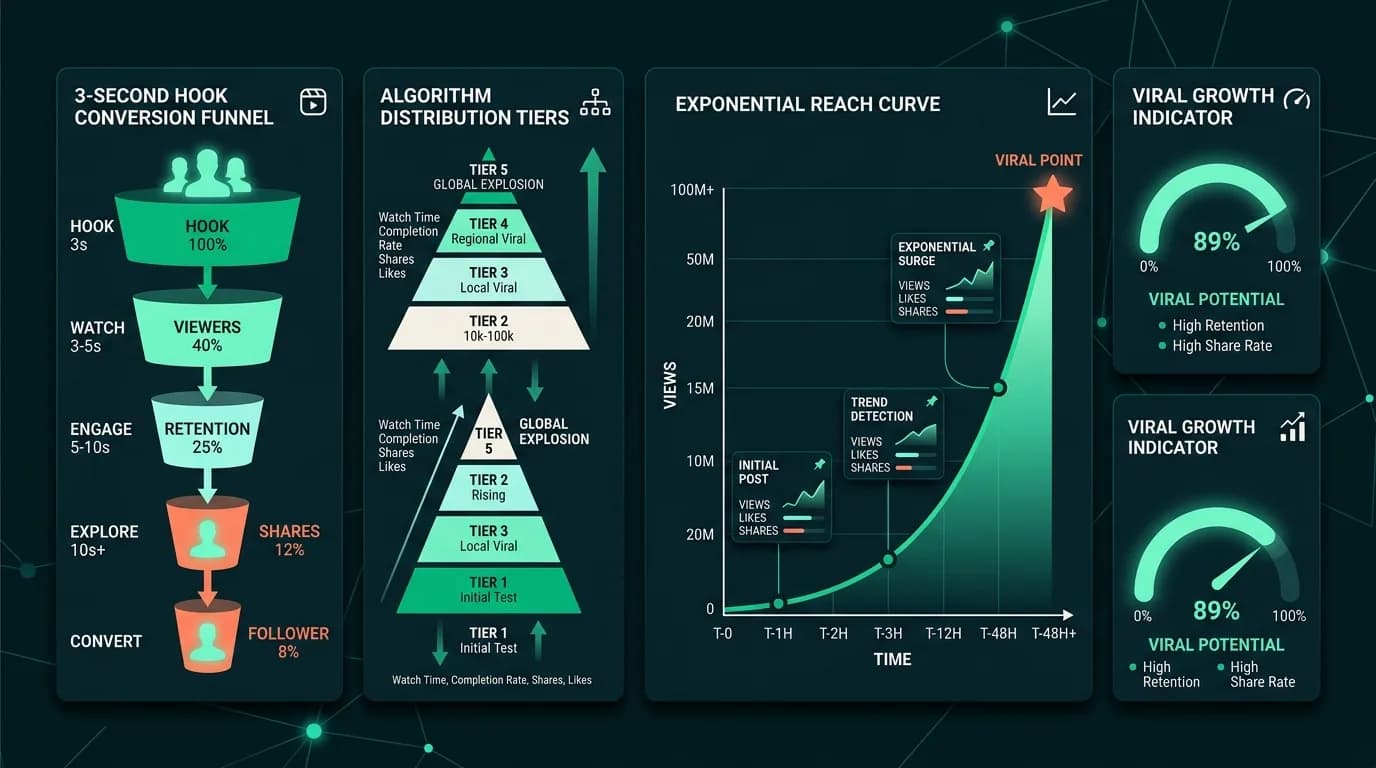
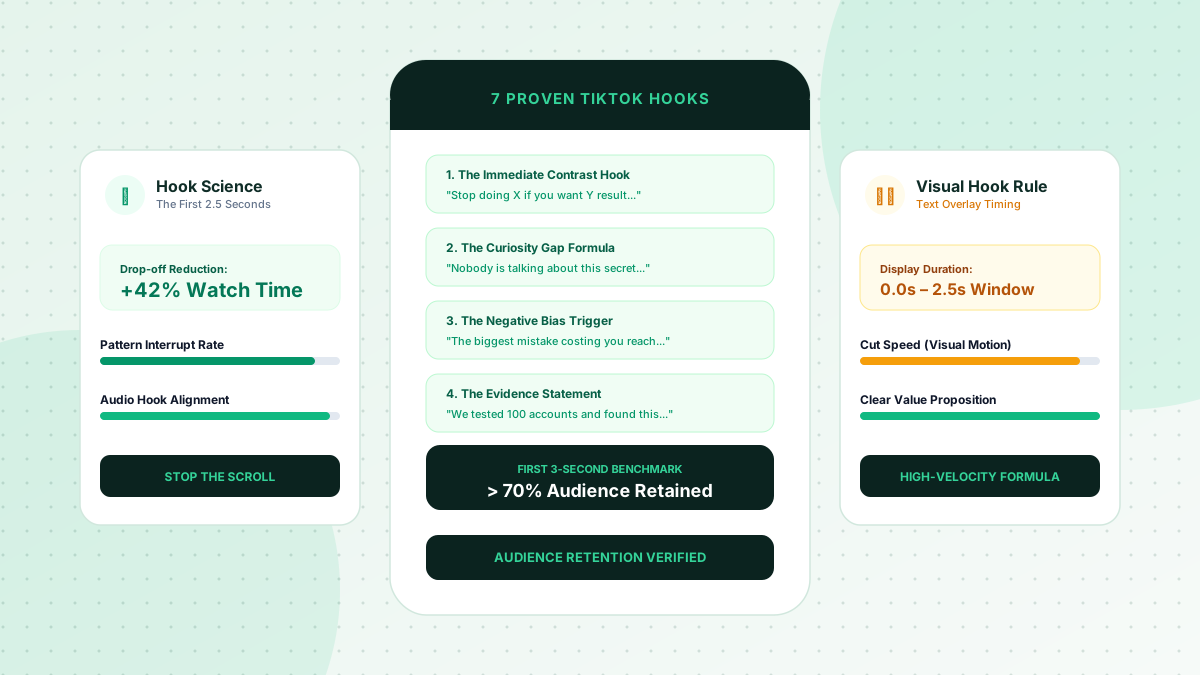
On TikTok, the first 2.5 seconds dictate the entire commercial and algorithmic outcome of your video. Because the For You page operates as a fast-paced discovery feed, viewers make an instantaneous subconscious decision to swipe or stay before you finish your opening sentence. If your 3-second retention drops below 60%, the recommendation engine terminates batch testing, stranding your video in low-view territory regardless of how valuable the rest of your content is.
Through empirical testing across creator accounts, we have identified 7 repeatable hook frameworks that consistently hold viewer attention, suppress swipe-away velocity, and signal high quality to TikTok's recommendation classifiers.
1. The Immediate Contrast Hook
This formula creates instant cognitive tension by challenging conventional assumptions within your niche.
- Structure: "Stop doing [Common Practice] if you want to achieve [Desired Result]."
- Example: "Stop posting 3 times a day if you want to grow on TikTok in 2026."
- Why it works: Human psychology is wired to avoid mistakes. Telling viewers that a familiar habit is actively hurting them forces a mental pause.
2. The Curiosity Gap Formula
The curiosity gap withholding framework introduces a high-value insight while deliberately withholding the answer until the mid-point of the video.
- Structure: "There is a reason top accounts never [Common Action], and it is not what you think."
- Example: "There is a reason top creators never use trending sounds anymore, and it comes down to search indexing."
3. The Negative Bias Trigger
Research into consumer attention shows that negative framing consistently outperforms positive framing in short-form video.
- Structure: "The single biggest mistake costing you [Metric] right now."
- Example: "The single biggest caption mistake that is silently killing your TikTok reach."
4. The Data & Evidence Hook
Positioning your video as empirical research rather than personal opinion instantly builds professional authority.
- Structure: "We tested [X Variables] over [Time Period], and here are the exact numbers."
- Example: "We analyzed 200 videos that crossed 1 million views, and 84% shared this one structural pattern."
5. The Relatable Vulnerability Opener
Connecting directly with a shared creator frustration builds fast emotional rapport.
- Structure: "If you feel like your views are stuck at 200 despite posting high-effort content, listen to this."
- Why it works: It addresses the exact pain point of your target audience, making the video feel personalized to their situation.
6. The "Secret Society" Insider Angle
Viewers are drawn to exclusive or hidden operational knowledge that industry insiders rarely share publicly.
- Structure: "What social media agencies charge thousands to tell you about [Topic]."
- Example: "What growth agencies charge $3,000 for that you can set up in 5 minutes."
7. The Direct Demonstration Hook
Instead of speaking, start the video mid-action with a visual payoff or startling statement already underway.
- Structure: Visual motion in frame 1 paired with an urgent on-screen question.
- Example: Showing an analytics dashboard with a dramatic upward traffic curve before saying a word.
Visual and Auditory Hook Rules for 2026
A verbal hook must always be reinforced by visual and auditory cues:
- On-Screen Native Text: Place bold, high-contrast native text in the upper third of the screen displaying your core hook during seconds 0 to 3.
- Cut Speed: Ensure at least one visual cut or camera angle shift occurs before second 2.5 to reset visual focus.
- Clear Enunciation: Pronounce your primary search keywords clearly so TikTok's automated speech recognition indexes your video into relevant search clusters.
Mastering these opening frameworks ensures your content clears initial algorithmic evaluation gates and reaches the audience it deserves.
Use a sustainable content strategy, and compare a one-time visibility package only if its scope, price, requirements, and refund terms fit your campaign.